Simulating axion quark nugget dark matter
University of British Columbia – Supervisor: Prof. Ludovic van Waerbeke
(September 2024 - May 2025)
While our description of the universe has continuously progressed through astronomy and physics, there are two glaring shortcomings: the dark matter problem, and the matter-antimatter asymmetry. Despite the concept of dark matter (DM) being introduced a century ago, it’s nature remains a mystery. And while we expect the universe to have created equal amounts of matter and antimatter, all astronomical observations point to a strong matter dominance. The axion quark nugget (AQN) dark matter model simultaneously resolves both of these issues.
Initially theorized to explain the similar amount (same order of magnitude) of regular and dark matter, AQNs also resolve the baryon asymmetry because they are composed primarily of regular matter. They are a macrosopic DM model composed of an extremely dense anti-quark core contained by an axion domain wall. AQNs are particularly interesting because they are dark not because they interact weakly/emit rarely because they are very sparse and so interact strongly but very infrequently. A long (but very digestible) AQN overview can be found here on arXiv
Because AQNs are thought to emit thermally – though very faintly – it presents the opportunity to image DM emission at large scale with modern space telescopes. I used hydrodynamic simulations to create ‘observations’ up to a redshift of including the AQN emission. I then directly compared these results both to observation limits of JWST and Euclid and preliminary data from the two. Through this, I concluded that JWST and Euclid telescopes are theoretically able to detect the AQN signal through employing component separation techniques to distinguish it from other background sources.
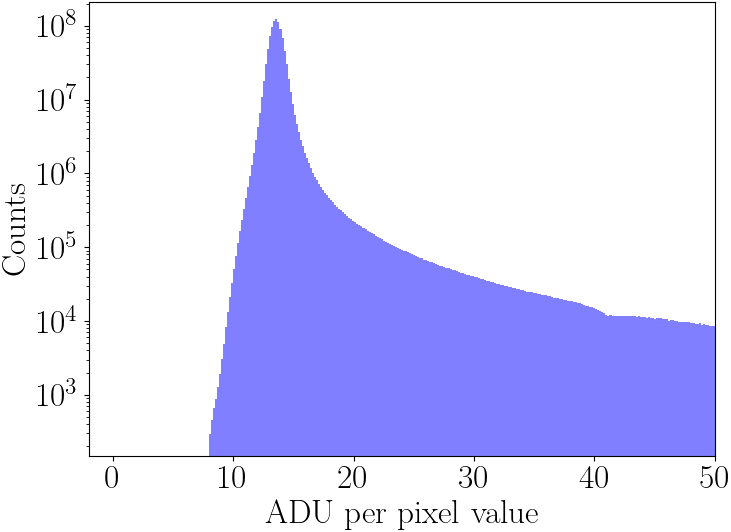
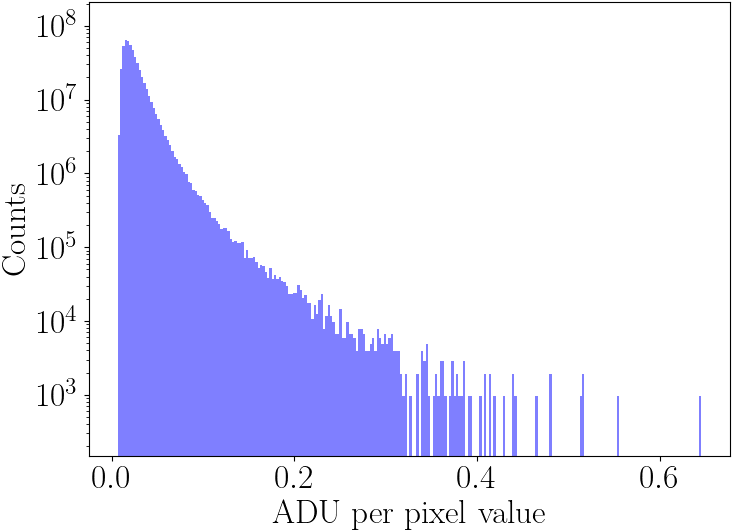 Figure: Analog to Digital (ADU) counts for Euclid telescope (left) and simulated 100g AQN observation (right). Euclid is sensitive down to ~0.1 ADU, placing the AQN signal in a detectable range.
You can find this project summarized in my undergraduate thesis here